Meta Just Paid US$18 Billion to Stop a Jury Finishing the Sentence
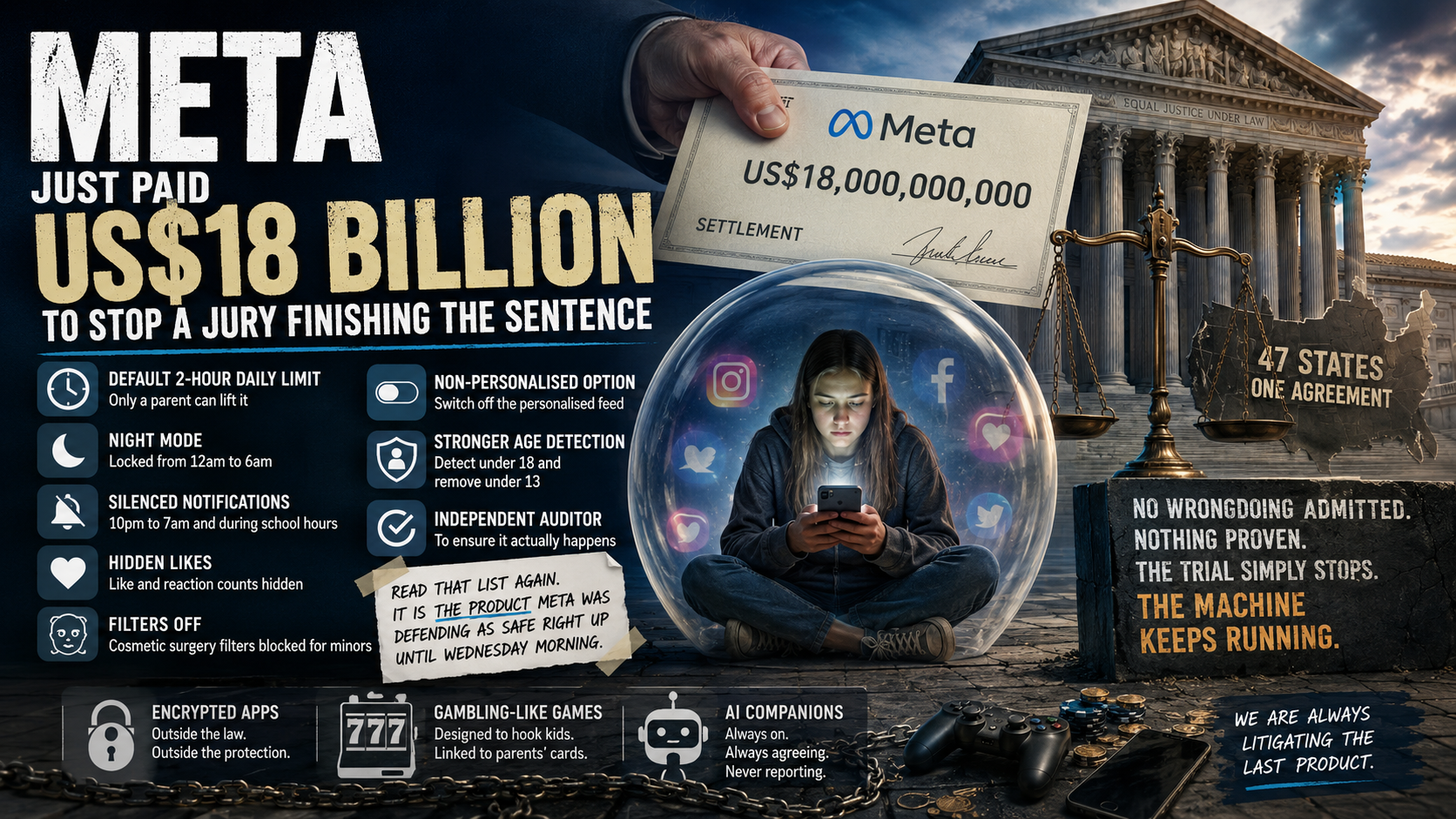
Meta has never conceded that its products harm children. It did not concede it this week either. It simply agreed to pay around US$18 billion, and to rebuild the machine.
The settlement filed in the Northern District of California on Wednesday ends a trial that had been running barely a week in Oakland, brought by a bipartisan coalition of state attorneys-general and resolving claims from 47 states. It came the day after Instagram's chief, Adam Mosseri, took the stand. No wrongdoing is admitted. Nothing is proven. The trial simply stops. I find this profoundly unsatisfactory.
What Meta has agreed to do is more interesting than what it has agreed to pay.
Within months, Facebook and Instagram have pledged that all accounts belonging to 13- to 17-year-olds will carry a default two-hour daily limit that only a parent can lift. A night mode will lock teenagers out between midnight and 6am. Notifications will be silenced from 10pm to 7am and muted again during school hours. Like and reaction counts will be hidden. Cosmetic surgery filters will be blocked for minors. There will be an option to switch off the personalised feed entirely. And the company have promised that they will deploy stronger technology to detect users under 18 and remove those under 13. An independent auditor will check that it happens.
Read that list again and notice what it is. It is a description of the product Meta was defending as safe right up until Wednesday morning.
The argument we were told we had lost
When Australia legislated a minimum age of 16, we were told by the platforms, and by the well-funded chorus that follows them around, that age assurance was technically unworkable, ruinous to privacy, and certain to fail. I was repeatedly lectured to about all the unintended consequences by people whose intended consequences had already been catastrophic.
Meta has now signed a court-enforceable agreement in California to build the very thing it told Australia could not be built.
I would enjoy that more if our own law were working better. It is not, yet. eSafety's three-month review found more than eight in ten Australian under-16s still using social media, most of them as often as before 10 December, with about half of those who kept their accounts saying no platform ever asked their age. That finding has been reported as the ban failing. I read it differently. The children did not defeat the law. The same platforms that are now acting - had declined to enforce it, and now one of them has admitted in an American courtroom that it could have.
Why the number is smaller than it looks
Eighteen billion dollars is a headline, not a deterrent. It is paid over a decade, which is roughly $1.8 billion a year against annual revenue in the order of $200 billion. On the day of the announcement Meta's share price rose. Snap's fell more than eight per cent. Markets are unsentimental readers of documents, and they read this one as a cost of doing business by a company that had just removed its largest legal uncertainty.
Look closer and it shrinks further. Only about 70 per cent, $12.7 billion, is unconditional. The remaining $5.3 billion is released only if TikTok and YouTube agree to matching payments and matching safeguards. The tougher provisions, including a one-hour daily limit rather than two, arrive only on the same condition.
Meta frames this as leadership, and calls on its peers to follow. It is also true that the cheapest thing $5.3 billion can buy is competitors carrying the same handicap. Either way, the protection of a 14-year-old in Bendigo or Baltimore has been made contingent on a commercial negotiation between three corporations. This is disgraceful and should unsettle us more than the size of the cheque.
What it does not touch
The settlement covers Facebook and Instagram. In my consulting room, the things that frighten parents most no longer arrive through either. They arrive through encrypted messaging apps that sit outside the scope of our law. Through games engineered in the visual language of poker machines, where a child buys coins with a card linked to a parent's account and learns the rhythm of the near-miss years before they can legally walk into a venue. Through AI companions that never sleep, never disagree and never tell anyone. This two-hour Instagram limit does nothing about any of it.
That is the structural problem with regulating one platform, one harm, one lawsuit at a time. We are always litigating the last product.
So what do I think Australia should do with this?
Three things.
Stop debating whether age assurance is feasible. It has been conceded. The PM should now enforce accordingly, and the $99 million penalty for systemic non-compliance exists to be used, not admired.
Legislate the design, not only the age. The most valuable clauses in this settlement are not the age checks. They are night mode, the non-personalised feed, the hidden like counts, the muted notifications. Those protections should not evaporate on a child's sixteenth birthday, which under our current law is precisely what happens.
And fund the repair. American states will direct billions towards youth mental health services and prevention. Australian children were part of the same experiment and will receive not one cent of it. Our young people were not collateral damage in someone else's market, they were in the market.
The question parents actually asked
For thirty years, parents have arrived in my rooms asking a version of the same question. Is it me, or is it the phone?
They have been reassured, gently and expensively, that it was probably them. That they were anxious, or nostalgic, or insufficiently digitally literate. That the research was contested. That correlation is not causation.
This week a company worth more than most nations paid US$18 billion rather than let twelve citizens of Oakland finish answering that question.
Parents can stop wondering. As I have said repeatedly these companies have the ethics of a cash register - and they just proved it.