The Very Hungry Class of Year 12
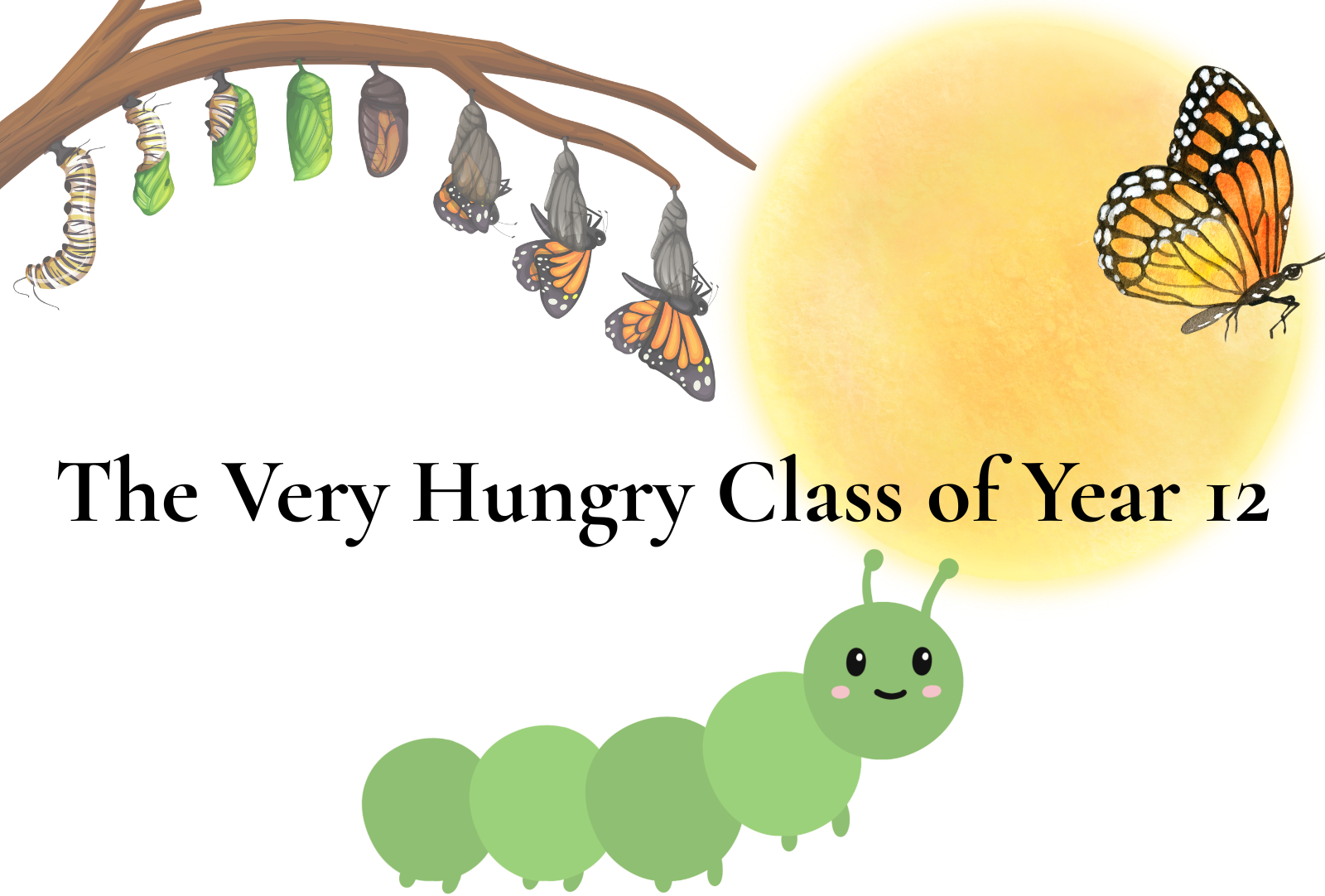
One of my favourite books to read to my children when they were little was The Very Hungry Caterpillar. If you've ever had toddlers, chances are you've read it so many times you could recite it from memory also. It has sold more than 60 million copies, been translated into dozens of languages and somehow still manages to delight children who insist on hearing it "just one more time" (usually five times in a row).
Here's a little-known fact: Eric Carle didn't originally write about a caterpillar. His first draft was called A Week with Willi the Worm. Thankfully, his editor, Ann Beach, gently pointed out that worms don't have quite the same career trajectory as caterpillars. It may be one of the greatest editorial interventions in publishing history, because as we all know, worms don't become butterflies.
At this time of year, when I work alongside Year 12 students and their increasingly anxious parents, I'm grateful Anne persuaded him to make the change. I've come to think The Very Hungry Caterpillar isn't just one of the world's greatest children's books. It's one of the best books ever written about adolescence.
Think about the story for a moment. A tiny caterpillar emerges into the world and spends the next week consuming absolutely everything in sight. One apple. Two pears. Three plums. Four strawberries. Five oranges. By Saturday all dietary restraint has vanished completely. Chocolate cake, ice cream, pickles, Swiss cheese, salami, lollipops, cherry pie, sausage, cupcakes and watermelon. If you've ever watched a seventeen-year-old boy arrive home after football training, you'll know this isn't fantasy. It's documentary.
Then comes the line we tend to skim over because we're already anticipating the butterfly. "That night he had a stomach ache."
It might be a throwaway sentence in the story, but not in real life.
Every year around this point in the school calendar I see the Year 12 equivalent of the caterpillar's stomach ache. Students who have spent thirteen years accumulating knowledge, experiences, expectations, disappointments, friendships, practice exams, co-curricular commitments and more than enough advice from well-meaning adults suddenly find themselves emotionally and physically full. They aren't broken. They're overloaded.
The remarkable thing about adolescence is that it's supposed to feel like this.
Teenagers are wired to consume. Not just information, but experiences. Relationships. Identity. Failure. Success. Risk. Embarrassment. Adventure. They are constantly taking in data about themselves and the world. Some of it is nourishing. Some of it is emotional junk food. Most of it arrives without a nutritional label. Their job isn't to get it all right. Their job is to experience enough of life that their brains can gradually work out what matters.
Unfortunately, modern education often mistakes accumulation for flourishing. We quietly encourage young people to believe that if they just consume one more study guide, complete one more practice exam, stay awake one more hour, they'll somehow become immune to stress. Yet brains don't work that way. At some point, more becomes too much.
That's why my favourite page in Eric Carle's book isn't the butterfly. It's the green leaf.
After the excess, after the stomach ache, the caterpillar eats one simple green leaf.
Not another banquet.
Not a productivity hack.
Not twenty more practice questions.
Just one green leaf.
How often do we prescribe the opposite to Year 12 students? Feeling stressed? Do more. Feeling overwhelmed? Work harder. Feeling exhausted? Stay up later. Somewhere along the line we've forgotten that sometimes the most productive thing a brain can do is recover.
Sleep remains the single most effective cognitive enhancer we know of. Better than another hour of revision. Better than another energy drink. Better than scrolling through social media looking at everyone else's colour-coded study timetable and wondering why your own life appears to be collapsing.
Then comes the part of the story that our culture is least comfortable with: the cocoon.
Eric Carle gives it almost no drama. The caterpillar builds a cocoon and waits.
Nothing appears to happen.
From the outside it looks like stillness. Inside, however, something astonishing is taking place. The caterpillar isn't simply growing wings. Much of its body is being dismantled and rebuilt into something entirely different. Transformation looks suspiciously like inactivity to people who don't understand biology.
The same is true of adolescence.
Parents often tell me they're worried because their teenager seems quieter than usual, more withdrawn, less certain of themselves. Sometimes that's a sign of mental ill-health, and we should never ignore it. But often it's something else entirely. It's the invisible psychological work of becoming an adult.
We live in a world obsessed with visible productivity. Every minute must be optimised. Every achievement posted. Every hour accounted for. Adolescence stubbornly refuses to cooperate. Some of its most important work happens where nobody can see it.
Recently I came across one of the most extraordinary scientific stories I've read in years. A ten-year-old Japanese boy named Jo Nagai wondered whether butterflies remembered anything from their lives as caterpillars. It sounds like the sort of question children ask that adults smile politely at before changing the subject.
Except scientists had already been asking exactly the same question.
Research has shown that moths trained as caterpillars to avoid particular smells still avoid those smells after emerging as adult moths. Despite undergoing one of nature's most astonishing physical transformations, something survives. Memory survives.
Jo wrote to one of the researchers, Martha Weiss. She wrote back. With her guidance he recreated a version of the experiment himself. His findings mirrored the original work.
I love this story, not because of the science alone, but because of what it says about curiosity. A ten-year-old asked a beautiful question instead of assuming somebody else already had.
But it also offers Year 12 students something far more important.
The butterfly remembers.
That's the message I wish every graduating student could hear.
If this semester feels confusing, exhausting, overwhelming or emotionally messy, it doesn't necessarily mean something has gone wrong. It may simply mean you're in your chrysalis. Transformation rarely feels graceful from the inside.
What survives this year won't be your chemistry mark or your ranking in English.
What survives will be your character.
Your kindness.
Your resilience.
Your curiosity.
Your friendships.
Your sense of humour.
Your capacity to get back up after disappointment.
The ATAR will open some doors and close others. That's true. But it has never been a reliable measure of wisdom, decency, courage, creativity or future happiness. After more than forty years working with young people, I've met plenty of high ATAR adults who aren't particularly fulfilled, and many average students who've gone on to build extraordinary lives.
Every September I find myself saying the same thing to Year 12 students.
Sleep.
Ask for help before you're drowning.
Stop comparing yourself to everyone else.
Run your own race.
And remember that your ATAR is something you receive, not someone you become.
Eric Carle probably never imagined his little caterpillar would become a metaphor for adolescence. But perhaps that's why great children's books endure. They keep revealing truths we weren't old enough to notice the first time around.
The caterpillar doesn't become a butterfly by avoiding the eating, the discomfort or the waiting. Every stage matters.
The overload isn't a detour.
The cocoon isn't a failure.
It's the process.
And one day, when the exams are over, the uniforms packed away and the school gates behind them, today's Year 12 students will discover something rather wonderful.
Like the butterfly, they'll emerge carrying far more of themselves than they realise.
And they'll remember all the experiences that make them who they are.