The umpire didn’t lose it. And your kids are watching your reaction.
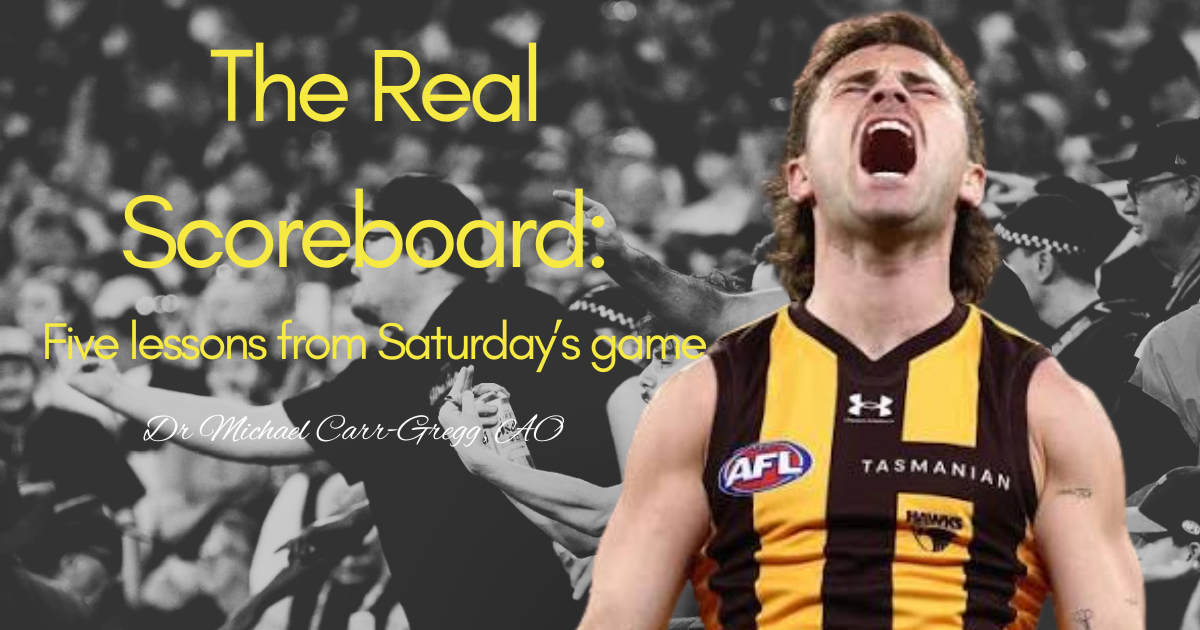
By Dr Michael Carr-Gregg
Let's start with the obvious. It hurt. Twenty-eight points down in the last quarter of a preliminary final, the Hawks stormed back in front of nearly 98,000 people, only for a holding-the-ball call against Jarman Impey to hand Hugh McCluggage a set shot with 18 seconds left. A goal after the siren made it nine points. Season over.
Then came the bottles, hurled toward the umpires as they left the ground.
Here is the uncomfortable truth. Every child in a brown and gold scarf on Saturday learned something, and it wasn't about football. They learned what grown-ups do when life doesn't go their way.
The thinking trap behind the bottles
Psychologists have a name for it: the fallacy of fairness. It's the belief that life runs on a rulebook we personally wrote, and that any breach is an outrage someone must pay for. It feels righteous. It is also a recipe for chronic resentment, because the world never signed the contract.
I see this trap in my consulting room every week. The teenager who failed because the teacher "hates me". The boy dropped from the firsts because the coach "plays favourites". Sometimes there's a grain of truth in it. It doesn't matter. The young person who parks their wellbeing in someone else's decision has handed over the keys to their own life.
Blaming the umpire is seductive because it's painless. It asks nothing of us. But a team doesn't lose a prelim in 18 seconds. It loses it across 120 minutes, including the long stretch where it fell 28 points behind. One decision is a moment. The margin is a story.
What kids take from it
Children don't do what we say. They do what we do. When Dad screams at the television that the game was stolen, a nine-year-old files that away as the correct adult response to disappointment. Find a villain. Get loud. Take no responsibility.
Kids who are taught to blame the umps grow into teenagers who blame the teacher, and adults who blame the boss. Kids who are taught to ask "what was in my control?" grow into people who can cope with a bad exam, a break-up, a job knock-back. That's not football. That's resilience, and it's the single best predictor of how a young person will travel through life.
There's a practical cost too. Community football has struggled for years to find and keep umpires, and abuse is a big reason why. Many of those umpires are teenagers themselves. Every parent who models contempt for the person with the whistle on Saturday night is making it a little less likely that there'll be someone to blow it at under-12s on Sunday morning.
What to say in the car on the way home
"I'm gutted too. It's okay to be sad about this." Name the feeling before you try to fix it.
"Maybe the call was wrong. Umpires are human. So are players, and they made mistakes too."
"Fair doesn't mean we always get what we want. Sometimes you do everything right and still lose."
"What could the Hawks have controlled? What will they work on over summer?"
"Did you see them come back from 28 down? That's what not giving up looks like."
"How do you think Jarman Impey is feeling tonight? What would you want your teammates to say to you?"
"Nobody who throws things at another person is a real supporter. Ever."
And what you don't say: "We were robbed." Three words that teach a child their disappointment is always someone else's fault.
Disappointment is a vaccine
We have become a bit allergic to our children's distress. We rush to soothe it, explain it away, or find someone to blame for it. But disappointment is not a toxin. It's a vaccine. Small doses, delivered in the safety of a family that loves you, build the immunity kids need for the bigger losses ahead. A heartbreaking prelim is about as safe a dose as life offers. Nobody died. The sun came up. There's a season next year.
So let them cry. Sit with them. Then, when the sting has eased, help them find the lesson. That sequence, feel it, then learn from it, is the whole game.
The real scoreboard
The Hawks will be back. They're young, they're good, and they've now stood at the door two years running. The team that beat them knows all about that: Brisbane lost plenty of big finals before they learned how to win them. I'd wager Sam Mitchell won't spend the summer talking about one free kick. He'll be talking about the 28 points.
The question is whether the rest of us can lose as well as they played.
The siren's gone. Your kids are still watching.